The Science-Based Formula
The most widely accepted guideline from nutritionists and sports scientists is to drink 30–40ml per kilogram of body weight per day under normal conditions.[1] This is far more accurate than a flat "8 glasses" recommendation.
Base daily water intake:
Example: 70kg person → 70 × 35 = 2,450ml per day
Daily Water Intake by Body Weight
| Body Weight | Sedentary (30ml/kg) | Average (35ml/kg) | Active (40ml/kg) |
|---|---|---|---|
| 50 kg (110 lbs) | 1,500 ml | 1,750 ml | 2,000 ml |
| 60 kg (132 lbs) | 1,800 ml | 2,100 ml | 2,400 ml |
| 70 kg (154 lbs) | 2,100 ml | 2,450 ml | 2,800 ml |
| 80 kg (176 lbs) | 2,400 ml | 2,800 ml | 3,200 ml |
| 90 kg (198 lbs) | 2,700 ml | 3,150 ml | 3,600 ml |
| 100 kg (220 lbs) | 3,000 ml | 3,500 ml | 4,000 ml |
Adjusting for Activity and Climate
Exercise: Add 500–1,000ml per hour of activity
During physical exercise, you can lose 500–1,500ml per hour through sweat. Add this to your baseline. For intense or prolonged exercise, consider electrolyte drinks rather than plain water.
Hot Weather: Add 500ml in warm climates
In hot weather (above 25°C / 77°F), your body sweats more for temperature regulation. Add 500ml to your daily baseline. In very hot conditions (35°C+), add 1,000ml or more.
Pregnancy & Breastfeeding: +300–700ml above baseline
Pregnant women need about 300ml extra daily. Breastfeeding mothers need even more — up to 700ml above their normal baseline — since breast milk is about 87% water.
Illness: Increase significantly when sick
Fever, vomiting, and diarrhea cause significant fluid loss. When sick, drink as much water as possible and consider adding electrolytes. Dehydration during illness can worsen symptoms and slow recovery.
Does Coffee Count as Water?
Yes — but not 1:1. Caffeinated beverages like coffee have a mild diuretic effect, meaning they cause your kidneys to excrete slightly more water. However, modern research shows the net effect is still positive hydration: a 250ml coffee contributes roughly 150–200ml of net hydration.
This is exactly why Suu uses a "dehydration factor" system for each beverage. When you log a coffee, Suu calculates its actual hydration contribution rather than counting the full volume. This is the most scientifically accurate way to track hydration — and it's a feature no other water app offers.
5 Practical Tips to Hit Your Daily Goal
1. Start your morning with 300–500ml
You wake up 6–8 hours dehydrated. Drinking water first thing in the morning jumpstarts your metabolism and sets you up for a hydrated day.
2. Use smart reminders
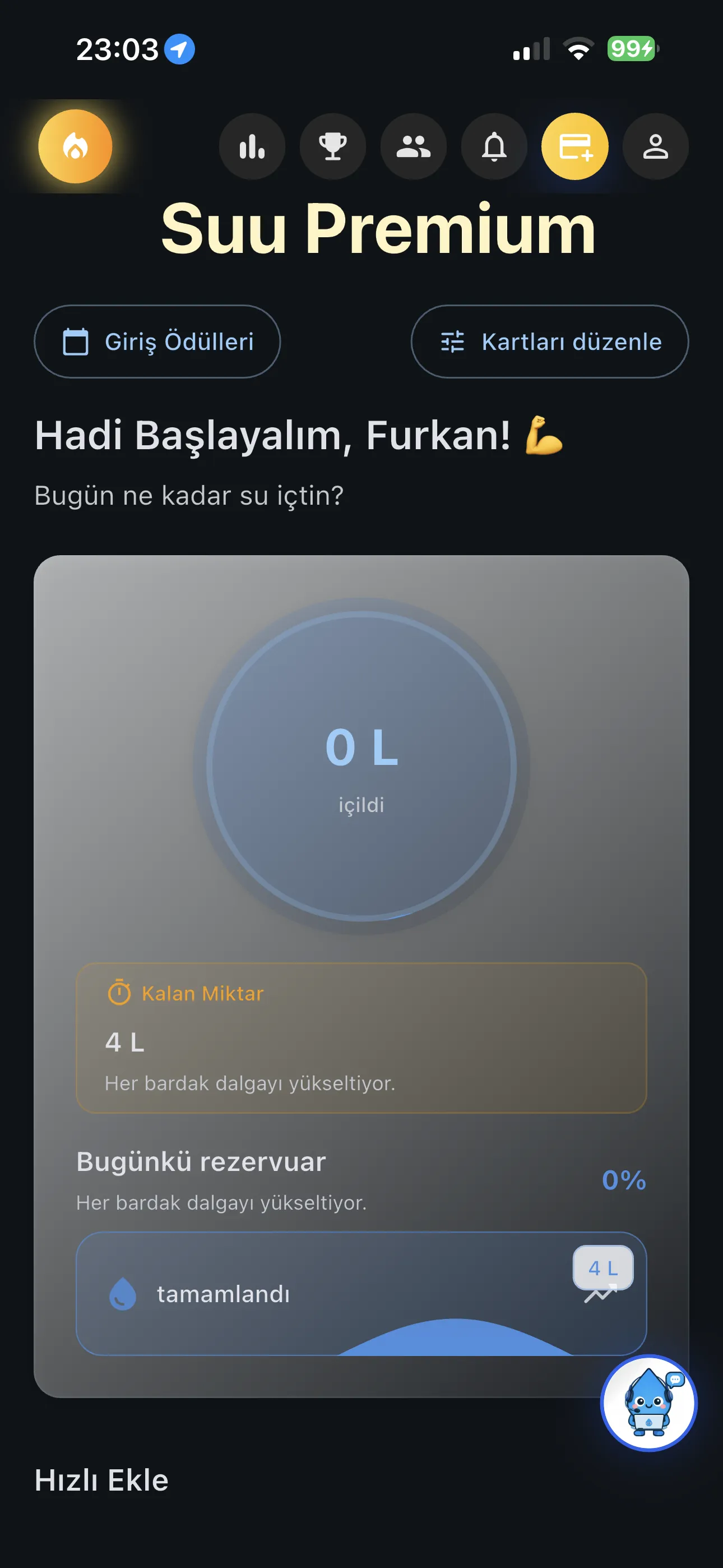
The Suu app sends goal-based notifications — not on a fixed timer, but when you're falling behind your personal target. This is far more effective than generic hourly reminders.
3. Drink a glass before each meal
Drinking 250–300ml before each meal adds 750–900ml to your daily intake without any effort — and can help with portion control.
4. Track from your Lock Screen
Suu supports iOS Lock Screen widgets, so you can log a drink with a single tap without even opening the app. The less friction, the more consistently you'll track.
5. Compete with friends
Suu's friend league system lets you compete with others on daily hydration. Social accountability is one of the most powerful habit-formation tools — knowing your friends can see your progress is a surprisingly effective motivator.
Frequently asked questions
Do I really need to drink 2 liters of water a day?
How much extra water should I drink when I exercise?
Does my water need change during pregnancy or breastfeeding?
Does coffee and tea count toward my daily water?
How much extra water should I drink in summer?
Scientific References
- EFSA Panel on Dietetic Products, Nutrition and Allergies. (2010). Scientific Opinion on Dietary Reference Values for Water. EFSA Journal, 8(3), 1459. DOI: 10.2903/j.efsa.2010.1459
- Popkin BM, D'Anci KE, Rosenberg IH. (2010). Water, Hydration and Health. Nutrition Reviews, 68(8), 439–458. PubMed: 20646222