Table of Contents
Why Hydration Matters During Exercise
When you exercise, your muscles generate heat. Your body's cooling system — sweating — kicks in to keep your core temperature stable. The problem is that every drop of sweat comes directly from your body's water stores, and those stores deplete faster than most people realise.
Sweat losses vary widely: a gentle yoga session might cost you 300–400 ml per hour, while a hard run in summer heat can push losses to 2 litres per hour or more. As soon as fluid losses hit just 1–2% of your body weight, performance starts to decline. At 2% dehydration, strength, endurance, and coordination all drop measurably[1] — and that's a level most exercisers reach without even noticing.
The consequences go beyond performance. Dehydration during exercise raises your heart rate for the same workload, impairs your ability to regulate body temperature, increases perceived effort, and — if severe — can lead to cramps, heat exhaustion, or heatstroke. Proper hydration isn't just about getting a good workout; it's about staying safe.
Before Exercise: Pre-Workout Hydration
The biggest mistake athletes make is starting a workout already dehydrated. If you haven't been drinking enough throughout the day, you're already behind before you lace up your shoes.
Pre-exercise hydration protocol (American College of Sports Medicine):
Drink 500 ml (about 2 cups) of water 2 hours before exercise, then 250 ml (1 cup) approximately 15 minutes before you start.
Drinking 2 hours out gives your kidneys time to process the fluid and excrete any excess, so you're starting well-hydrated rather than bloated. The smaller top-up just before exercise ensures you're fully ready without the discomfort of a sloshing stomach.
One reliable check: look at the colour of your urine before you head out. Pale yellow means you're well hydrated. Dark yellow or amber means you need more water before you even begin.
During Exercise: Staying Topped Up
Once you're moving, your goal is to drink enough to offset sweat losses without overdoing it. The current scientific consensus recommends drinking to thirst for most recreational exercisers — but thirst can lag behind actual needs, especially in cooler weather or during high-intensity work when you're focused on the effort.
During-exercise guideline: Aim for 150–250 ml every 15–20 minutes for moderate-to-intense activity. For very high-intensity exercise or extreme heat, the upper end of that range is appropriate.
For sessions under 60 minutes at moderate intensity, plain water is all you need. For longer or harder sessions, keep reading — electrolytes become relevant.
Practical tip: don't wait until you feel thirsty. Set a mental timer or use a sports watch to remind yourself to drink at regular intervals. Suu can send you reminders throughout the day, ensuring you stay on track even on your rest intervals between sets.
After Exercise: Recovery Hydration
Post-workout rehydration is where most people fall short. The rule of thumb: for every 450 g (1 lb) of body weight you lost during the workout, drink approximately 600 ml of water to fully restore fluid balance.
The most accurate way to know how much you sweated: weigh yourself before and after exercise (without clothes, after towelling off). A 1 kg drop in weight roughly equals 1 litre of fluid lost. Aim to replace 125–150% of that loss over the next few hours, since you'll continue to lose some fluid through urine and breathing as you rehydrate.
- Drink 600 ml per 450 g of body weight lost
- Spread rehydration over 2–4 hours rather than drinking everything at once
- Eating a meal with sodium (salt) helps your body retain the fluids you drink
- Urine should return to pale yellow within 2 hours of finishing your workout
Sports Drinks: When Do You Actually Need Them?
Sports drinks are marketed aggressively, but the science is clear: for the majority of workouts, plain water is entirely sufficient. Sports drinks are designed to replace two things lost in sweat — electrolytes (primarily sodium, potassium, and magnesium) and carbohydrate fuel for prolonged effort.
The threshold where sports drinks offer a real advantage is continuous exercise lasting more than 60 minutes, especially at high intensity or in hot and humid conditions. Below that threshold, the sugar and calories in most sports drinks add more than they benefit.
If you do opt for a sports drink, choose one with sodium (at least 400–500 mg per 500 ml) and around 30–60 g of carbohydrate per hour of activity. Alternatively, natural options like coconut water or a banana with water provide electrolytes without the artificial colours and sweeteners found in many commercial products.
One important note: Suu tracks 91 beverages, including sports drinks, and applies a dehydration factor to each one. That means when you log a sports drink, Suu calculates its actual net hydration contribution — not just the raw volume — so your daily total stays accurate.
Tracking Exercise Hydration with Suu
Knowing the guidelines is one thing; actually hitting your targets on a hard training day is another. This is where having a smart hydration app pays off.
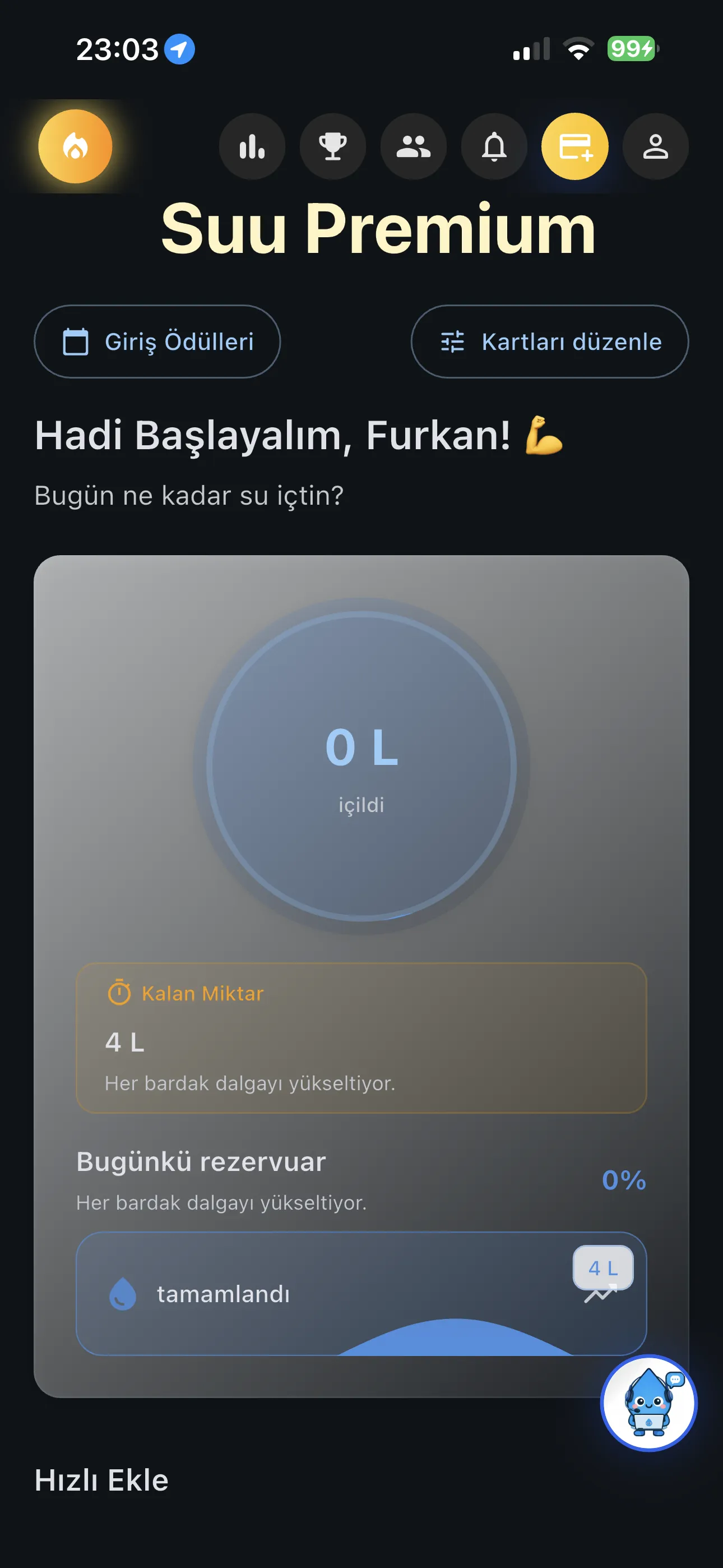
Suu includes a "Very Active" activity level setting that automatically adjusts your daily water intake goal based on how hard you're training. Set your activity level to match your training load, and Suu recalculates your personal daily target to account for the additional fluid losses from exercise. You don't need to manually add extra water — it's already built in.
- Activity-adjusted goals — "Very Active" mode increases your daily target automatically on training days
- Apple Health & Google Health integration — Suu syncs with both platforms, so your workout data and hydration data live in one place
- Smart reminders — Goal-based notifications fire when you're falling behind, not just on a rigid timer
- 91 beverages with dehydration factor — Track your pre- or post-workout sports drink accurately, not just by volume
- Detailed analytics — See your weekly and monthly hydration trends alongside your training load
The Apple Health and Google Health integration is particularly useful for athletes. Your workout sessions recorded in those platforms automatically inform Suu's context, making it easier to understand the relationship between how hard you trained and how much water your body needed that day.
Frequently asked questions
How much water should I drink before a workout?
Should I drink water or sports drinks during exercise?
How much water do I lose during a 30-minute run?
Do I really need to drink water while swimming? I'm already in water!
How much water should I drink after a workout?
Scientific References
- Sawka MN, et al. (2007). American College of Sports Medicine Position Stand: Exercise and Fluid Replacement. Medicine & Science in Sports & Exercise, 39(2), 377–390. PubMed: 17277604
- Killer SC, Blannin AK, Jeukendrup AE. (2014). No Evidence of Dehydration with Moderate Daily Coffee Intake. PLOS ONE, 9(1), e84154. PubMed: 24416202